
Holiday Hosting and Your Aerobic Septic System in North Texas
Between Thanksgiving and New Year's, a lot of North Texas homes go from three or four people to eight or ten. Extra showers, extra laundry, a dishwasher running every night and a kitchen producing more fat and food scraps than usual all land in the same place: your septic system. For homes on city sewer, that is a minor inconvenience. For homes in Collin, Grayson, Denton, Hunt and the surrounding counties with an aerobic treatment unit (ATU), it deserves a little planning.
The good news is that aerobic systems handle holiday crowds well when the water and the waste arrive at a manageable pace. Here is how to keep yours running smoothly from the first guest to the last leftover.
Why an aerobic system notices a crowd
An aerobic treatment unit relies on a living population of microbes that need a steady supply of wastewater and oxygen. According to Texas A&M AgriLife Extension, any extreme influx of wastewater flow or strength can impair the unit's performance. The system is affected by the amount, the strength and the timing of what enters it.
Most residential aerobic systems are rated to treat about 500 gallons a day, or roughly 60 gallons an hour, based on the same Extension guidance. That hourly number matters during the holidays. A normal clothes washer uses 30 to 40 gallons in a load, so several loads back to back, plus showers, can exceed what the unit can treat in an hour even if the daily total looks fine. Your permit paperwork or the label on the control panel should list your system's rated capacity. If you are not sure what it is, find out before the guests arrive.
Keep in mind that guests do not change how the system was designed. Texas A&M notes that design flow is based on the home's square footage or number of bedrooms, whichever is larger. A house designed for a family of four does not automatically grow when twelve people show up, so the goal is to spread out the extra use.
Spread out the water
The simplest holiday rule is to stretch water use over the whole day instead of bunching it up.
- Laundry: Both the EPA and Texas A&M advise spreading loads over time rather than doing everything in one day. Wash towels and bedding for guests a load or two at a time, not all on Saturday morning.
- Showers: If you have a full house, encourage staggered showers instead of everyone getting ready at the same hour. Multi-head showers and large jetted tubs can send big volumes quickly, and Extension guidance specifically lists whirlpool tubs as heavy water users.
- Dishwasher: Run it once at night after the kitchen quiets down, not between every course of the meal.
- Leaks: A single leaking or running toilet can add as much as 200 gallons a day, according to the EPA. With extra people using bathrooms, a hidden leak is easier to miss. TCEQ suggests a simple check: add dye to the toilet tank and see whether color shows up in the bowl within 10 minutes without flushing.
Protect the system in the kitchen
Holiday cooking is when most homeowners accidentally overload the organic side of the system. The EPA lists cooking grease and oil among the things that should never go down the drain, and it advises limiting or eliminating a garbage disposal. Texas A&M explains why: a disposal adds more waste to the system, the undigested food takes longer to break down, more water is used rinsing the sink, and smaller particles take longer to settle.
A few practical habits go a long way:
- Pour turkey drippings, bacon grease and frying oil into a container, let it cool, and put it in the trash.
- Scrape plates and pans into the garbage or compost before washing.
- Skip the disposal for potato peels, coffee grounds, bones and rich leftovers. The EPA and Texas A&M both list coffee grounds as something that adds to sludge.
- Do not add septic "boosters," enzymes or other chemical additives. TCEQ's guidance for septic owners specifically says not to, and notes that some can harm the tank's operation.
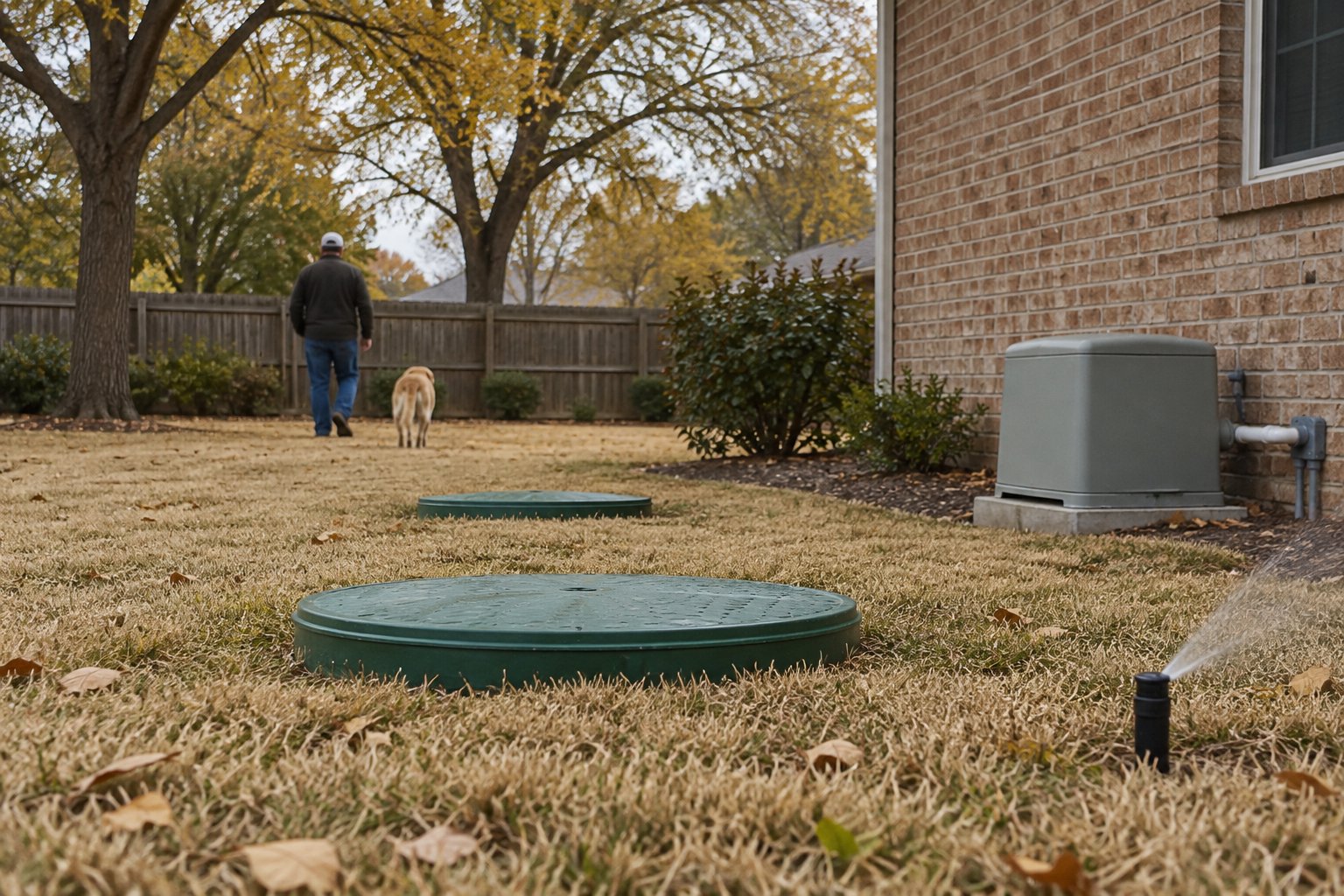
Watch the cleaning products and the guest bathroom
Aerobic microbes are sensitive to what goes down the drain. Texas A&M notes that toxic drain cleaners, antibacterial soap and heavy use of bleach can all affect the biology of the system, and that a cleaning product labeled "Danger" can kill the microbes and should be used rarely or never. Holiday cleaning before and after a party is a common source of a sudden chemical load, so spread the cleaning out and rinse sparingly.
Consider a polite note in the guest bathroom as well. Only human waste and toilet paper belong in the toilet. Wet wipes, even those labeled "flushable" or "septic safe," do not break down the way toilet paper does. The Extension guidance points out that "septic safe" usually refers to the ability to flow through pipes, not to breaking down in the tank.
Before the guests arrive and after they leave
A short pre-holiday check can prevent a very bad weekend:
- Test the alarm. If your control panel has a test button, use it, and make sure you know where the silence switch is.
- Listen for the air pump. It should be running. A changed sound or a silent unit is worth a call before the holiday, not during it.
- Check your disinfection supply. If your system uses chlorine tablets, TCEQ says to use calcium hypochlorite tablets certified for wastewater disinfection, and never swimming pool tablets, which are a different chemical and are not approved for this use.
- Look at your service schedule. If your system has a maintenance contract, a visit may already be due. TCEQ rules call for licensed maintenance and reporting about every four months for systems using secondary treatment, and the first two years after installation require a licensed provider. Ask your provider whether any component or sludge level needs attention before a busy week.
Afterward, watch for slow drains, gurgling, odors, an alarm that will not clear, or soggy ground in the spray area. If the house sat full and then suddenly empties, you may also notice the opposite problem. Texas A&M explains that a vacation or extended absence reduces the microbial population, so after guests leave or you return from travel, bring water use back up gradually.
Frequently Asked Questions
How many overnight guests can an aerobic septic system handle?
There is no single number, because it depends on the system's rated capacity and how the water use is spread out. Check your permit or control panel label for the design flow, and focus on staggering showers and laundry. If you regularly host large groups, ask a qualified provider whether your system and tank size suit that pattern.
Can I use my garbage disposal at Thanksgiving?
You can, but it is better not to. The EPA says that if you use a disposal, your tank will need to be pumped more often, and Texas A&M says households with disposals need more maintenance. Scraping food into the trash is the easiest way to protect the system.
What should I do if the alarm goes off during a gathering?
Texas A&M advises calling your maintenance provider and reducing nonessential water use until the system is fixed. An alarm can indicate a high-water or low-air-pressure condition. Pause laundry and dishwashing, and avoid long showers in the meantime.
Should I have the tank pumped before the holidays?
Not automatically. TCEQ says that for aerobic units, pumping depends on the depth of sludge and the manufacturer's recommendations. A service visit can measure the levels so you pump when it is needed, not just by the calendar.
If you want a second set of eyes on your aerobic system before the holiday season, or you are already seeing signs of trouble, contact us through our quote page. Our team serves homeowners across Collin, Grayson, Denton, Rockwall, Fannin and Hunt counties and can help with inspections, pumping, maintenance and repairs so your gathering stays about the food and the family.
